


Technology is evolving at a rapid pace, and the digital space attracts more people every day. Social media has long ceased to be just a place for communication — today it is a powerful promotion tool. Facebook, Instagram, and other platforms bring together billions of users, and messengers have become full-fledged sales and communication channels. Large companies and thought leaders have long been building businesses around their pages with multi-million audiences.
In this reality, a natural question arises: is it worth investing in a website if social media can already bring in clients? The answer is clear — yes, it is. Social networks are great for attracting attention and generating interest, but they work as an entry point. The website is the main platform where the client makes a decision, learns about services, prices, doctors, and submits a request.
Having a professional website is important for medical facilities of any type: dental clinics, private doctor's offices, general medicine centers, multidisciplinary medical centers, diagnostic laboratories, and specialized clinics (surgical, orthopedic, cosmetology, etc.).
In this article we look at why a clinic needs its own website, which design elements help build patient trust, and what the page structure should be so that the resource works not just as a business card, but as an effective tool for attracting and retaining clients regardless of scale and focus.
What tasks should a dentistry clinic website solve
A clinic website is more than an online business card. It is a full-fledged tool for communication, trust, and sales. It not only helps attract new patients but also reduces the psychological barriers that often arise before a dental visit.
Key tasks of a clinic website:
- building trust through real patient reviews
- online booking without the need to call
- transparent pricing for budget planning
- clear communication at every stage of interaction
- presentation of comprehensive solutions to increase average order value
- convenient payment options
Real patient stories are the strongest influence. Positive and even constructive negative reviews help form an objective view of the clinic. This reduces fear of the unknown and often becomes the deciding factor when choosing a doctor.
Today’s patient values speed and convenience. The ability to choose the date and time of an appointment independently through a booking form significantly increases loyalty and reduces the load on front desk staff.
Clinic website development
At first glance, creating a website may seem like a complex and technically confusing process. However, with the right approach and a clear algorithm, this task becomes understandable and sequential. We have systematized the key development stages to simplify the process as much as possible for clinic managers and doctors who want to create an effective online resource without unnecessary difficulties.
Design development
Design is the first impression of the clinic and its doctors. It is the visual component that builds trust before the patient starts reading the text or exploring the list of services. Therefore, it is important that the site is designed in a thoughtful style, maintains a balance between aesthetics and functionality, and remains convenient, clear, and logically structured.
Order and structure — the foundation of trust
Imagine this: a potential patient visits the clinic website but sees chaotically placed information, overloaded pages, and inconsistent styling. Such a resource raises doubts about the clinic’s professionalism. The person is unlikely to want to continue exploring or book an appointment.
Clear structure, harmonious design, and intuitive navigation create a sense of order, competence, and care for the patient even before the first visit.
Structure development
The next key step is building a logical site structure. It determines how convenient and clear the resource will be for the user. A well-thought-out page architecture allows the patient to navigate quickly, find the information they need easily, and move to booking without unnecessary steps.
A clear system of sections, logical tabs, and a thoughtful order of information create a positive impression of the clinic before the first contact. Structure is the foundation on which the effectiveness of the entire site is built.
Essential clinic website sections
For the site to work effectively and build trust, it should include key sections that help the patient get the necessary information quickly:
- About us — introduction to the clinic, its values, and approach to work
- Doctors — presentation of specialists with photos, qualifications, and experience
- Services — structured list of services with descriptions
- Prices — transparent information about treatment costs
- Blog — useful materials and tips from doctors
- Reviews — real patient stories
- Certificates and licenses — proof of qualification
- Promotions — special offers
- Contacts — phone, address, map, opening hours
Important functionality
In addition to informational pages, the site should include tools for convenient interaction with patients:
- Online booking — ability to choose appointment date and time independently
- Online chat — quick consultation and clarification of details
- Callback — prompt handling of potential client requests
Choosing a CMS
There are many platforms and content management systems (CMS) for creating a clinic website. However, not all of them are equally convenient and flexible. Many solutions require deep technical knowledge or lengthy setup, which can complicate the launch process.
One of the most popular options is WordPress — a universal platform that allows you to create both simple business card sites and full corporate resources.
WordPress offers:
- a wide selection of themes (paid and free)
- flexible design customization
- ability to install plugins for online booking, SEO, blog, contact forms
- scalability for the future
A custom website built from scratch is also an option. This is a more complex and expensive path, but it allows you to create a unique solution fully tailored to the clinic’s needs.
Conclusion: key takeaways
For any service business, a website has long ceased to be a luxury — it is a necessity. Medical facilities, including dental clinics, are no exception. While you postpone the decision, competitors are already working online and attracting new patients through their own resources.
Creating a website requires a comprehensive approach. It is important to think through every stage: from structure and design to technical implementation and further promotion. If you ignore even one of these components, the resource may not deliver the expected results.
A well-developed website is a tool for trust, communication, and steady clinic growth.
Frequently Asked Questions
What key elements should be considered when creating a clinic website?
What design should you choose for a clinic website?
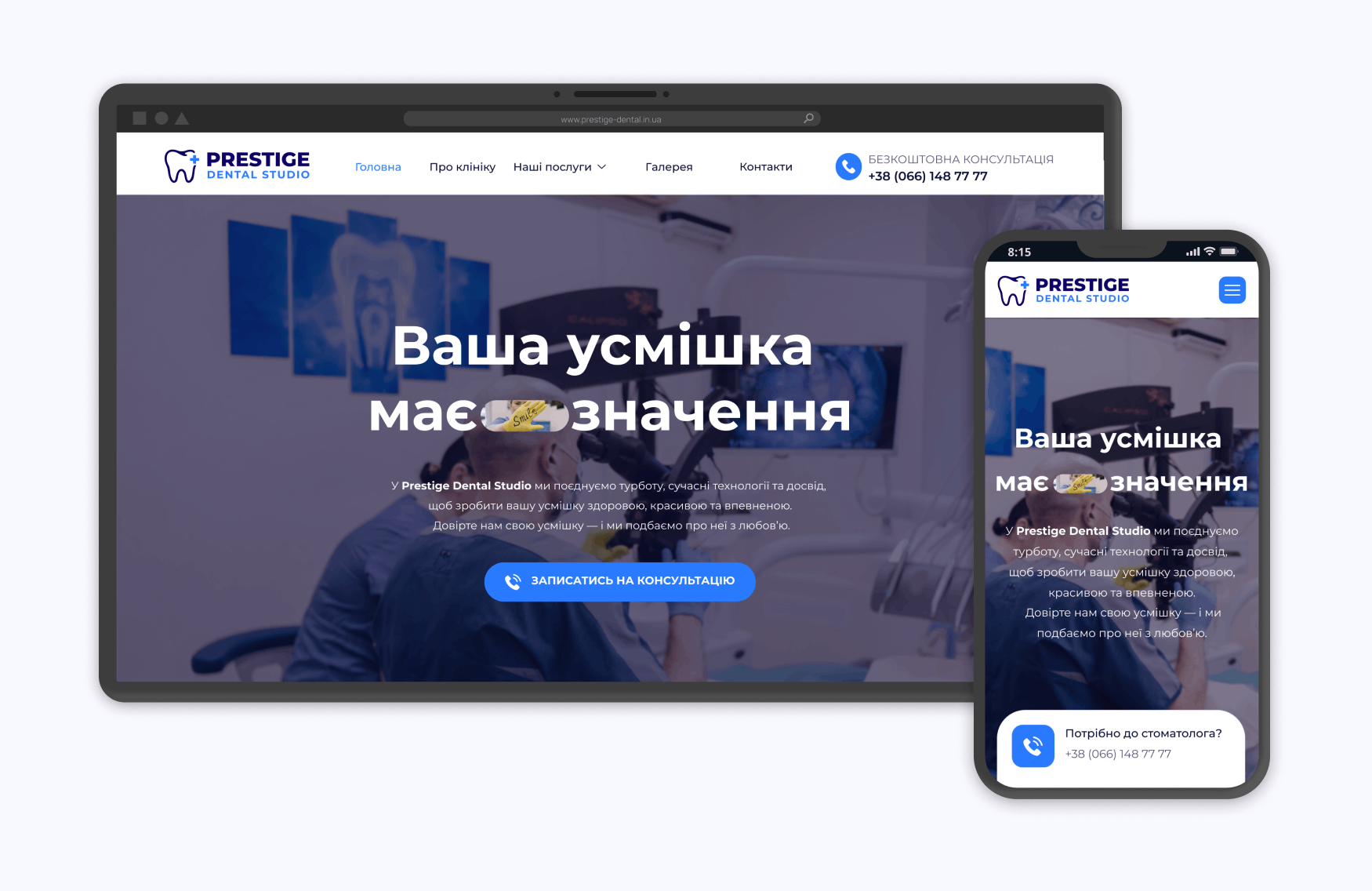

Prestige Dental Studio — a modern dental clinic in Mykolaiv
Corporate website for a modern dental clinic designed to build trust from the very first screen. The project combines a clear service structure, transparent pricing, and a convenient user experience for patients.