Homeland

Real-time driver communication platform

Homeland

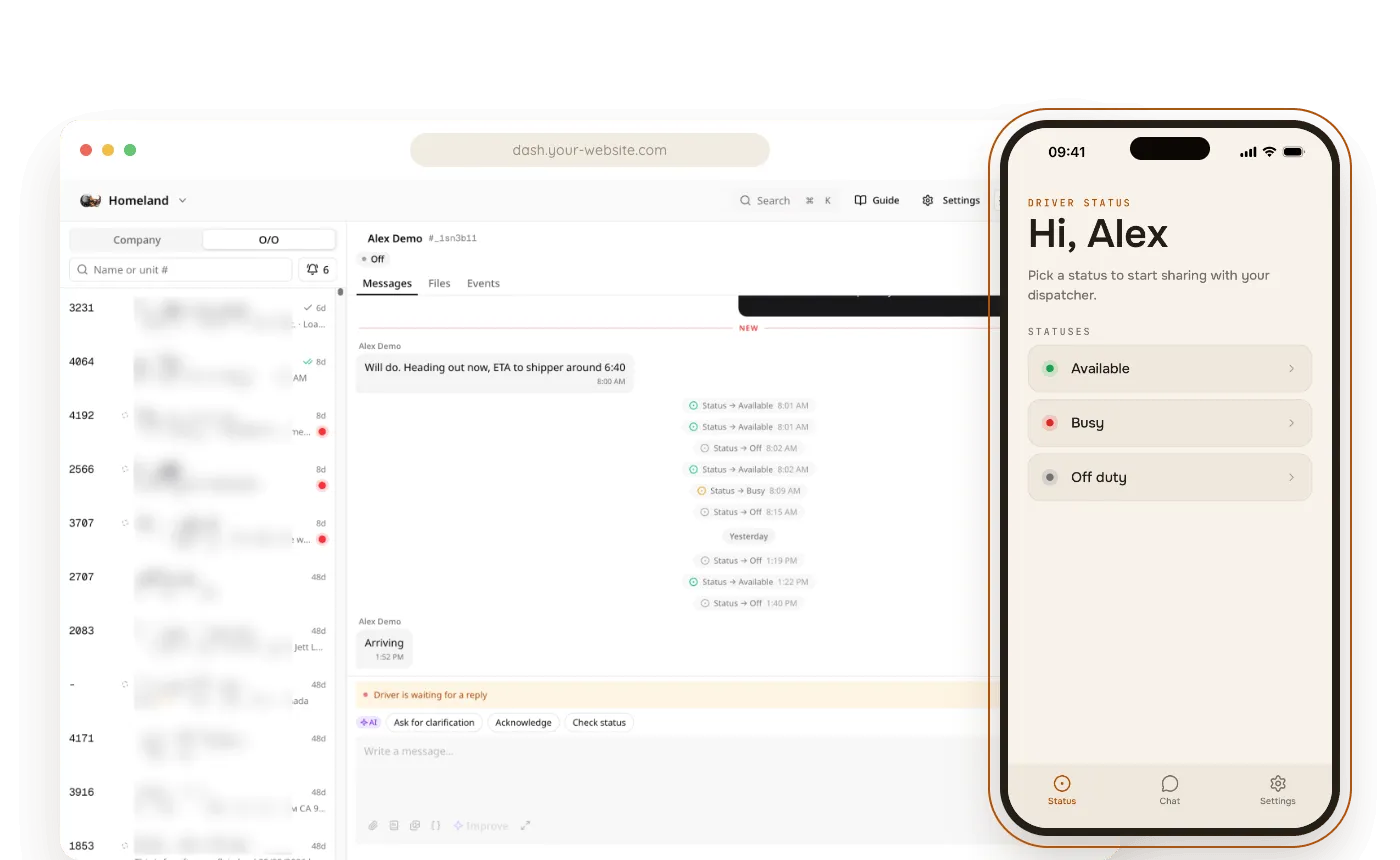
A real-time communication and driver management platform for a US trucking company: a dispatcher dashboard, a driver mobile app, and a backend deeply integrated with the company's TMS. The platform replaced phone-call check-ins with live driver statuses, automated location sharing, and AI-assisted messaging — built once and shipped for multiple carrier brands from a single codebase.

Schedule a meeting with our Product/Account Manager to discover more of our projects.

Country

USA

Industry

Logistics

Our Participation

Frontend, Backend, UI/UX, Product Design, Mobile, DevOps, QA

Our client is a trucking company operating in the United States, and a long-term partner: we built their first dispatcher dashboard and driver app, and have kept evolving the product alongside their operations ever since. As the fleet grew, the biggest remaining cost was the "check call" — is the driver available, where is the truck, when will it be free — which still ran on phone calls, costing dispatcher time and interrupting drivers on the road.

For the latest generation of the platform, we redesigned the driver-dispatcher workflow from the ground up: a real-time dispatcher dashboard, a native-quality driver app, and a backend that keeps everything in sync with the company's transportation management system. Drivers now report availability in one tap, share their location automatically, and exchange documents with dispatch in a single thread — while dispatchers see live statuses across the entire fleet without picking up the phone. The platform was also re-architected as a multi-carrier product, so the client can run additional carrier brands on the same system with their own apps, domains, and identity.

Goals set to Qberry

  • Replace phone-based check calls with structured, real-time driver statuses and automatic location updates.
  • Design and develop a dispatcher dashboard focused on driver communication: live chat, status monitoring, and a triage system that surfaces conversations needing attention.
  • Design and develop a driver mobile app for iOS and Android with a one-tap status flow, background location sharing, and rich messaging.
  • Integrate bidirectionally with the company's existing TMS, keeping driver profiles, statuses, and locations consistent across both systems.
  • Architect the platform for multi-carrier operation, so several brands can run on one codebase with separate apps, theming, and data scoping.
  • Roll the new generation out to drivers and dispatchers already using the previous versions — with zero disruption to daily operations.

Driver status and live location — without the phone calls

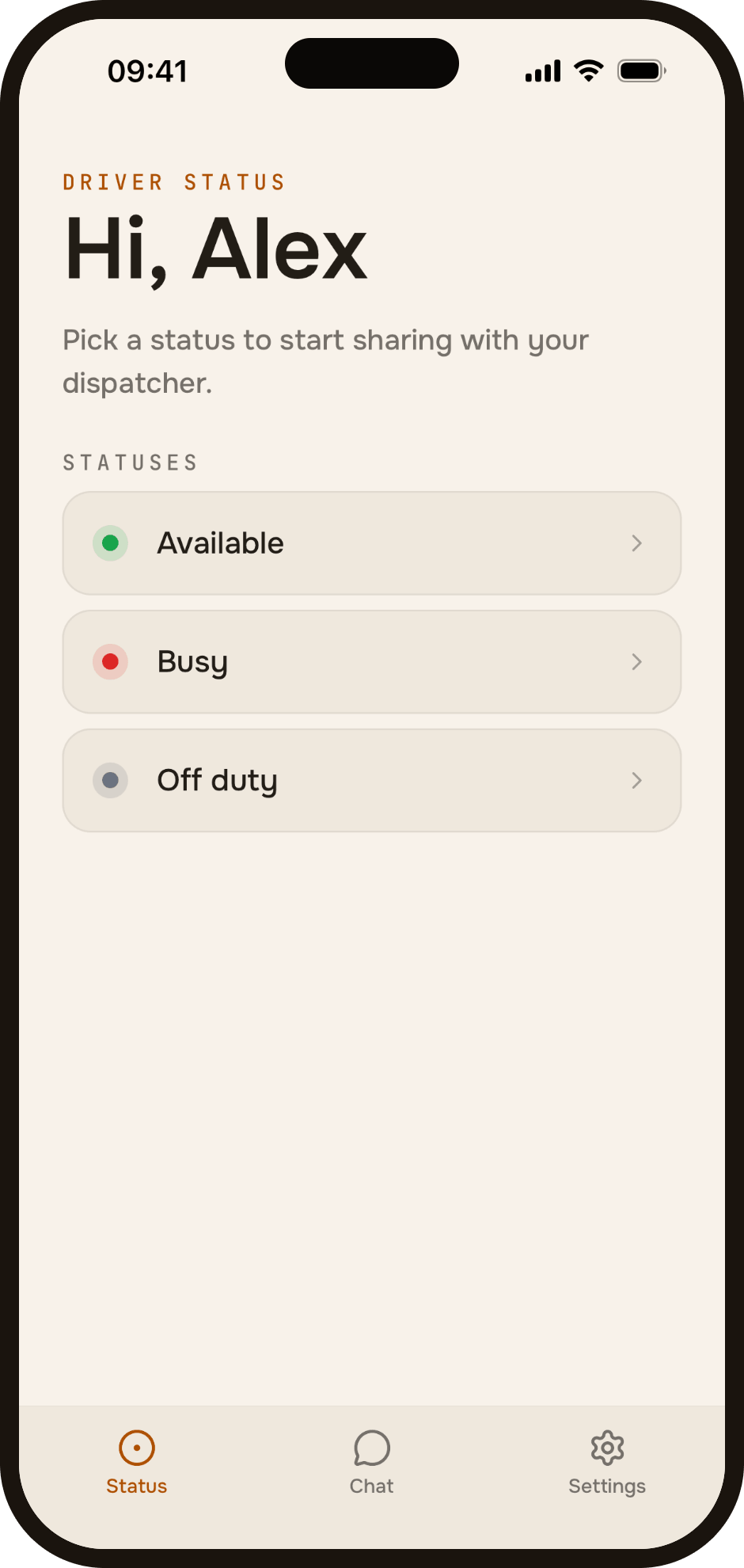
The heart of the platform is a simple contract: the driver taps a status — Available, Busy, or Off duty — and dispatch instantly knows the state of the truck. Each status carries useful detail: when and where the driver becomes free, an off-duty reason and return date, or a note for dispatch. While a driver is available, the app shares their location automatically at a fixed interval — even with the app closed — and shows a live countdown to the next update right on the driver's Lock Screen, so location sharing stays transparent rather than hidden. On the backend, an automated check-in engine watches for stale statuses and locations and nudges the right driver at the right time, flagging the conversation for the dispatcher only when a human actually needs to step in.

A dispatcher workspace built around conversations

Instead of a wall of tables, dispatchers get a communication hub where every driver is a live conversation: real-time messages with delivery and read receipts, typing indicators, pinned messages, replies, and priorities. An attention system flags chats that need a response and lets dispatchers resolve or snooze them, turning a noisy inbox into an ordered queue. Reusable message templates, a shared media library, and scheduled broadcast messaging make repetitive communication fast, while unified search finds any driver, message, or document in seconds. The dashboard ships as an installable progressive web app with push notifications, so dispatchers stay reachable beyond the browser tab.

Documents and media, straight from the cab

Rate confirmations, bills of lading, and proof-of-delivery paperwork travel through the same chat thread as everything else. The driver app includes a native document scanner that auto-crops pages into clean multi-page PDFs, and supports photos and videos with on-device compression. Uploads are chunked and resumable — built for real-world cellular coverage — and the media pipeline normalizes images, transcodes video, and transcribes audio in the background. AI-generated summaries describe every attachment, so a dispatcher can search for a document by what's in it, not just by filename.

AI-assisted dispatching

AI works in the background as a communication assistant. Dispatchers can improve a drafted message with one click, pick from AI-suggested quick replies, and rely on automatic language handling for a multilingual driver workforce — the driver app itself ships in three languages. Incoming attachments are automatically described and indexed, feeding the platform-wide search. The result is faster, clearer communication without adding another tool to anyone's workflow.

Two-way TMS integration

The platform doesn't replace the company's transportation management system — it extends it. Driver profiles sync inbound through webhooks with a scheduled reconciliation sweep as a safety net, while statuses, notes, and location updates flow back outbound in near real time. Every exchange is authenticated, logged, and monitored, with automatic alerts to administrators if the integration misbehaves. Dispatchers keep working in the tools they know, and both systems always agree on where every driver stands.

Multi-carrier by design

The client operates more than one carrier brand, and the platform treats that as a first-class requirement rather than an afterthought. A single codebase produces fully branded driver apps — separate App Store and Google Play listings, icons, color palettes, legal pages, and push-notification infrastructure per brand — while drivers and their data are scoped to the carrier they work with. Dispatchers switch between carriers inside one dashboard, and each brand connects to its own TMS tenant. Launching an additional carrier is a configuration exercise, not a new development project.

Evolving a live product, generation after generation

This is the third generation of the driver app and the second generation of the dispatcher dashboard we've built for the client — each replacing its predecessor while the fleet kept running. The rollout was engineered to be invisible to users: the new app adopts the previous version's credentials during the store update, so drivers stayed signed in without re-onboarding. Passwordless email-code authentication removed the most common support request, and old and new generations ran side by side against the same backend until the switch was complete. That's the advantage of owning the full stack across generations — upgrades feel like updates, not migrations.

Timeline

Project on Support

Type project

Driver app & dispatcher dashboard

Our participation

Frontend, Backend, UI/UX, Product Design, Mobile, DevOps, QA

Web Technologies

Backend

Laravel
Laravel
PHP
PHP

Frontend

React / Inertia.js
React / Inertia.js
TypeScript
TypeScript

Mobile Technologies

Cross-platform
Flutter
Flutter
Expo
Expo
homeland/app_status_default

Description screen:  The status screen is the driver's home base. Three clear states — Available, Busy, and Off duty — replace the check call: one tap tells every dispatcher the truck is ready for loads, and location sharing starts automatically.
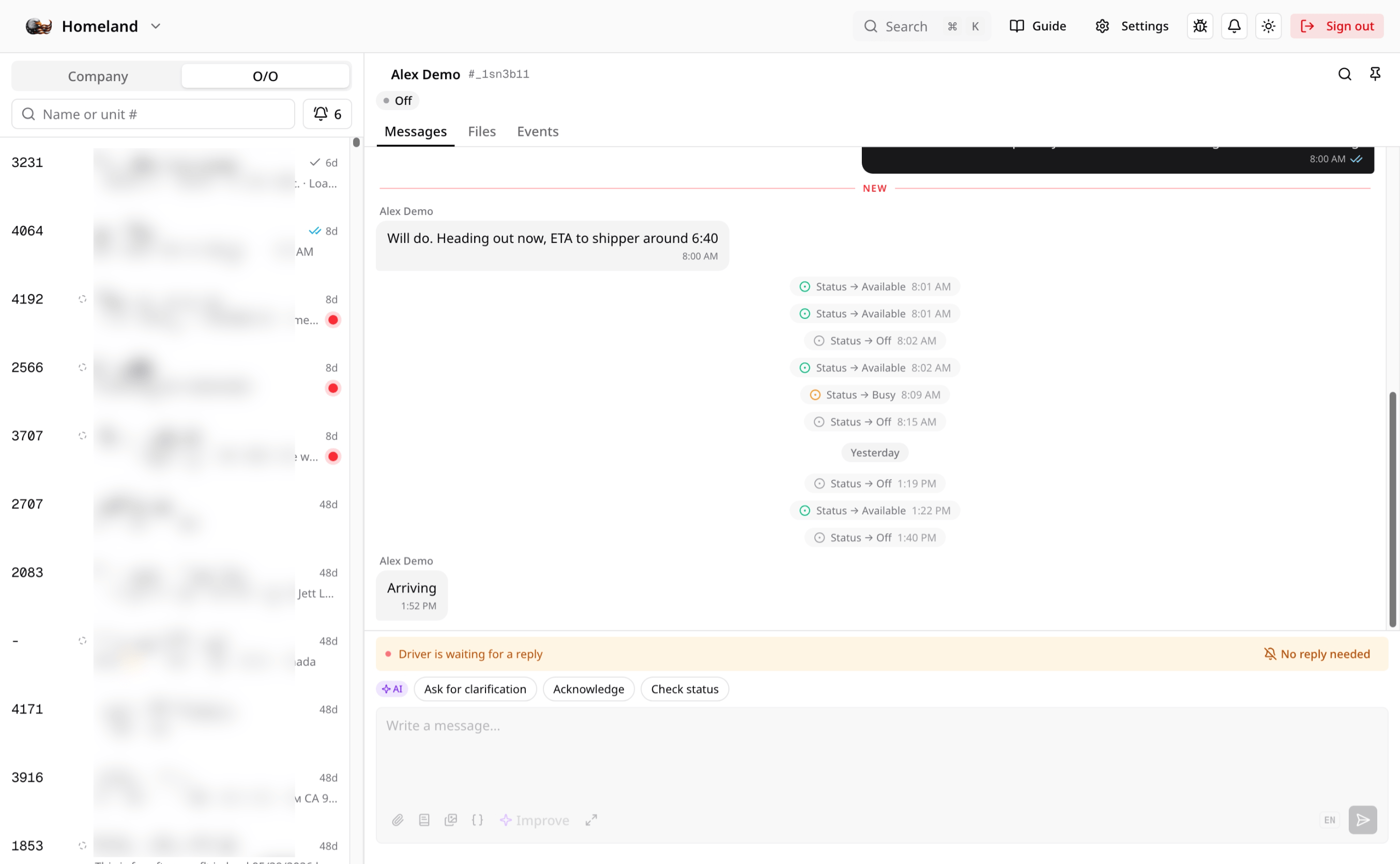
homeland/dash_chat_workspace

Description screen:  The dispatcher workspace puts the whole fleet's communication on one screen: the chat list with live driver statuses and attention flags on the left, and the active conversation with read receipts, pinned messages, and the driver's status timeline on the right.

Home
Web Dev
Mobile Dev
Startups
Design